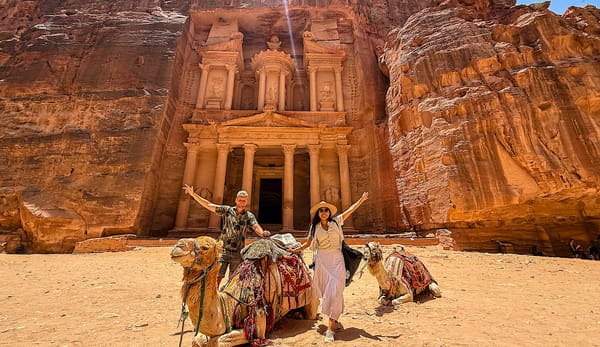

 Paloma

Table of contents
Known as the 'Rose City' for its stunning pink-hued rock facades, Petra attests to the ingenuity of the Nabataean civilization and remains one of the world's most extraordinary archaeological sites.
Whether you're a history buff, an adventure seeker, or simply in awe of Petra's majestic allure, this guide offers everything you need to plan an unforgettable visit.
Discover essential tips, must-see highlights, and insider insights to make the most of your journey to this iconic Wonder of the World.
Petra at a glance
Medium/Hard- Distance
- 3.4 mi (5.5 km) one-way
- Time needed
- 6 hours total
- Elevation gain
- about 800 steps
- Starting point
- Petra Visitor Center
- Parking
- Petra Free Parking or Petra Visitor's Free Car Park
- Cost
- 50/55/60 JOD, or free with the Jordan Pass
- Crowds
- Medium to High
- Best months to go
- May to October
- When to go
- Early morning or later in the afternoon to avoid crowds and the brutal sun
- Sun exposure
- High
Quick history of Petra
Although the area known as Petra has been inhabited since 8500 - 5500 BC, the city thrived under the Nabataean Empire from the 1st century BC.
The Nabataeans were a nomadic Bedouin tribe, and many believe they built the famous structures there, such as the Treasury. However, the exact date of Petra's construction is unknown.
In AD 106, Petra was annexed to the Roman Empire as Arabia Petraea. The city continued to thrive during this period until a large earthquake in 363 AD destroyed much of it. This, along with shifts in trade routes, eventually caused the city's decline and abandonment.

Getting to Petra
Petra is located in Wadi Musa, southwest of Jordan. It is 240 km south of Jordan's capital, Amman, and 120 km north of the Red Sea town of Aqaba.
To reach Petra (Wadi Musa), you can drive by yourself for about 3 hours. The drive is pretty straightforward once you leave Amman.
You can also reach the ancient city by taking a four-hour bus ride. If you're planning to visit during high season and/or national holidays, book in advance.

Entrance Fees to Petra
With Jordan Pass
Petra entrance fees are included in the Jordan Pass, which also includes entrance fees to many other attractions and waives visa entry fees. This is why I highly recommend getting a Jordan Pass if you stay in the country for at least three days.
Without Jordan Pass
In 2026, tickets to enter Petra will cost 50, 55, and 60 JOD per person for a one-day, two-day, or three-day pass, respectively.
If you visit Petra on a day trip from a neighboring country, you must pay 90 JOD per person.
If you don't get the Jordan Pass, you'll pay these prices directly at the entrance, in cash or by card. The Jordan Pass doesn't lower the price of a standalone Petra ticket; it bundles it with other attractions and waives your visa fee instead.
Dress code for Petra
Jordan is a Muslim country, so dressing conservatively is generally advised. This means covering your shoulders and knees, especially if you're a woman. However, I saw several guys wearing shorts, which seemed acceptable.
Jordanians are used to foreigners dressing differently, so something more revealing probably wouldn't be a problem, but you would definitely get stared at.

Options to explore Petra (on your own vs hiring a guide)
A great way to explore Petra and learn more about its history would be to hire a guide at the visitors' center. Hiring a guide should cost around 50 JOD per day per group.
Note, however, that visiting with a guide will make your journey longer, since the guide will stop at every important site and explain its story. So, if you're short on time, hiring a guide might not be the best idea.
On the other hand, visiting Petra on your own gives you the freedom to tailor the pace and itinerary, but you will need to do more research to fully understand its history and importance.
What to bring to visit Petra
- Sunscreen, hat, and sunglasses - the UV index can get pretty high during the day. While you'll have shade in the Canyon, the trail after the Treasury is pretty exposed all the way to the Monastery.
- Plenty of water and snacks—As I mentioned above, you will find opportunities to buy water and snacks along the trail; however, the prices might be higher than if you brought your own supplies.

Other things to know before visiting Petra
- You'll find relatively well-maintained restrooms every few miles inside the archaeological sites.
- A restaurant sits halfway on the trail from the Visitor's Center to the Monastery, and a coffee shop is at the Monastery.
Petra, stage by stage

1 Visitor Center to Treasury
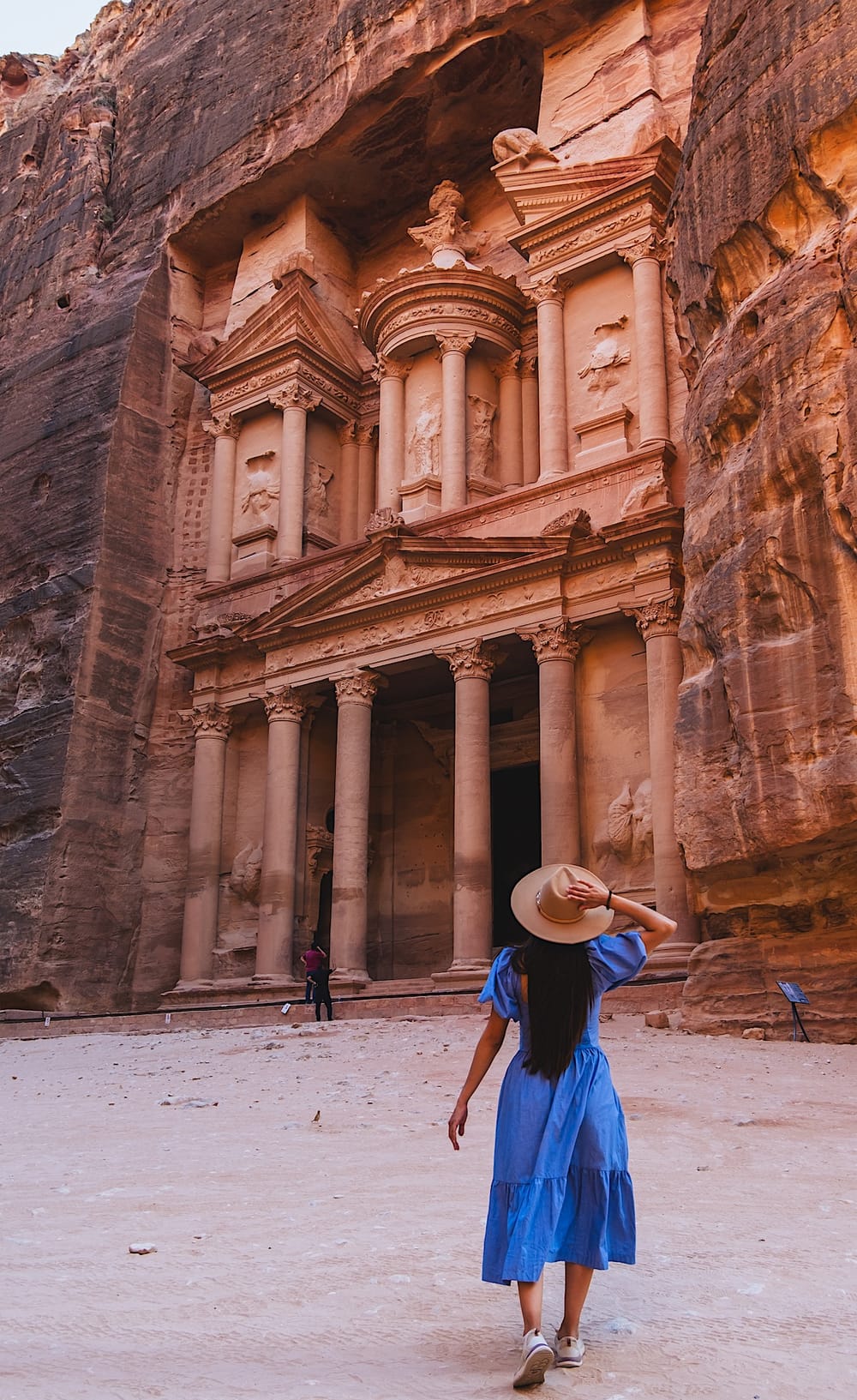
If you thought you would see the famous facade of the Treasury as soon as you entered Petra, think twice. To reach this landmark, you must walk for about 45 minutes through the Siq, a magnificent canyon that will make your jaw drop.
Unfortunately, you can't go inside the Treasury facade itself.
You can continue up some stairs to the right of the Treasury to snap a picture from a different angle. This will cost you 10 JOD, and it's not included in the Jordan Pass.

2 Treasury to Royal Tombs
Further along the trail, you will find the only Roman theater in the world carved into the rock.
Not far away, to the right of the trail, are the Royal Tombs. Deviate from the main trail for a closer look and to explore inside.

3 Royal Tombs to Monastery
Come back to the main trail to continue the adventure.
Not far from the Royal Tombs, you will encounter the remains of the massive 7000 m2 Great Temple, and soon after, you will reach a Restaurant.
The way gets confusing here, but stick to the path straight from behind the public restrooms (not the restaurant restrooms). Soon enough, you will reach the base of the staircase leading to the Monastery.
Get ready to climb the 800 steps up to the Monastery, believe me, it is worth it! Alternatively, if you're not up for the challenge, you can hire a donkey to carry you up.

Alternative route:
If you'd rather skip the climb up to the Monastery, you can walk the trail in the opposite direction, starting at the Monastery and ending at the Visitor's Center.
To do this, you must take a shuttle from the Visitor's Center to Little Petra and pay for a 4x4 to bring you closer to the Monastery. You will then walk only about 30 minutes to reach the Monastery.